
Floating docks and fixed docks are different fixtures for different conditions. Many waterfront homeowners who lack the necessary expertise see the decision between the two as budget-based. Budget is an important consideration, but the water conditions on the property are the main driving force. A fixed dock that looks great in a contractor’s portfolio may be the wrong structure for a site with four feet of tidal swing. Getting that call right before signing anything is what separates a dock that performs well for twenty years from one that needs major intervention in five.
A company offering marine construction services will assess site conditions before making any recommendations. They’ll look at tidal range, water depth at low tide, bottom composition, and wave exposure. Those four factors do most of the filtering. The list of remaining options after a site assessment is usually shorter than most homeowners expect.
Why the Floating vs. Fixed Decision Starts With Your Waterfront
A site with highly fluctuating water levels behaves differently from a calm protected cove with stable depth. That difference narrows the dock options, often before cost or aesthetics become the real question.
What Water Depth and Bottom Conditions Actually Determine
Floating docks need enough depth at low tide to avoid grounding. The minimum varies by pontoon system and boat draft, but two to three feet at low water is a common working threshold. If a site drops below that at low tide, a floating dock either grounds out or needs to be positioned so far from the shore that it becomes impractical.
Bottom composition shapes the fixed dock calculation. Driven pilings require a bottom that can hold them: dense sand, clay, and soft rock all work well. Pure loose mud or very shallow bedrock create complications. Rocky hard-pan bottoms can make piling installation expensive or impractical, and a site with the wrong bottom may need helical anchors or an alternative foundation approach.
Tidal range is the clearest differentiator between the two types. Fixed docks set their deck elevation at a calculated height above mean high water, usually twelve to eighteen inches above that mark. On a site with a one-foot tidal range, that elevation stays usable through any tide. On a site with a four-foot tidal range, the deck sits too high above the water at low tide for comfortable boarding. What should be an easy boarding point now requires a ladder.
Dock Construction Options: Floating and Fixed at a Glance
How a Floating Dock Works
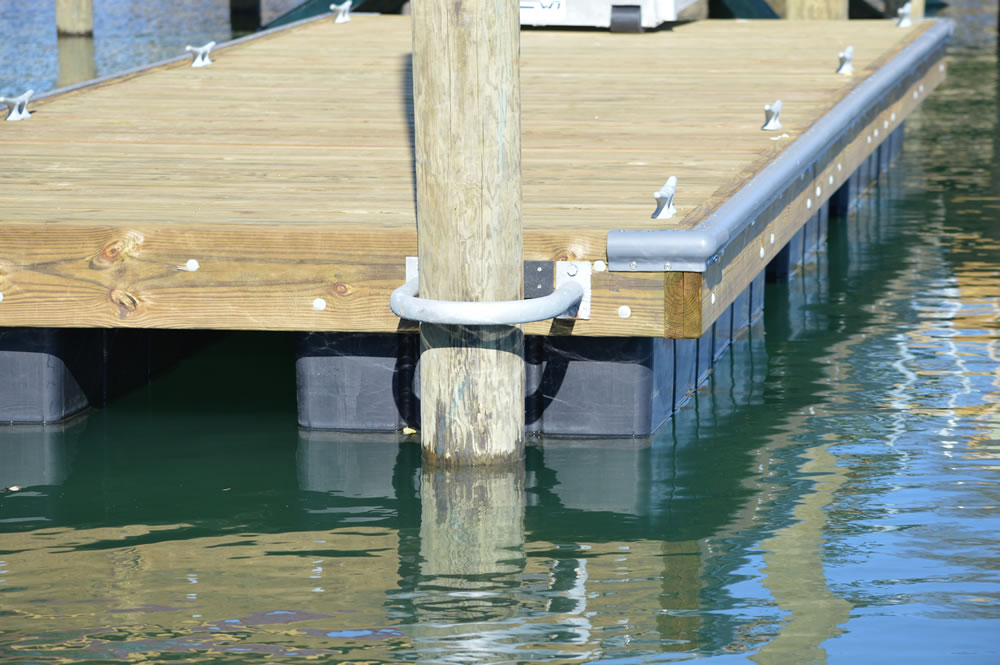
A floating dock keeps its deck at a consistent height relative to the water surface, regardless of tide or seasonal level changes. The deck rides on pontoons or modular float sections, usually high-density polyethylene, that displace enough water to support the structure and everything on it. The whole assembly is held in position by guide pilings it slides along, or by anchor cables and chains in locations where driven pilings aren’t used.
The main functional advantage is the consistency in deck height. Stepping from dock to boat remains consistent throughout the tide cycle. Floating dock construction typically uses aluminum framing for the structural elements, with composite or pressure-treated decking on top. The float system is the component with the finite lifespan. Everything else is maintained the same way a fixed dock is maintained.
How a Fixed Dock Works
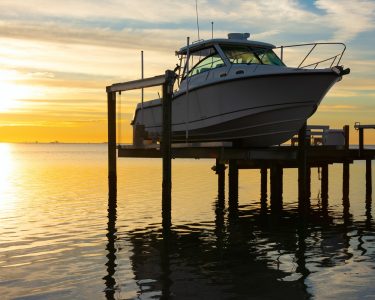
A fixed dock sets its deck at a permanent elevation, supported by driven pilings or posts set into the bottom. As the name suggests, it’s rigid and doesn’t move. Elevation above mean high water is calculated to keep the surface usable through normal tidal fluctuation. The site’s tidal range directly affects how well that calculation holds up over time.
Fixed docks tend to feel more stable underfoot than floating structures, especially in locations with boat traffic or wave action. They’re also more suitable for complex configurations like L-shapes, T-heads, and branching fingers. Material choices include wood decking over timber or steel pilings, composite decking, and aluminum-framed systems. Each material has its own lifespan and maintenance profile.
Where Each Type Wins and Where It Loses
Tidal range above three feet is almost always more conducive to floating. When water moves that much, it’s harder to keep a fixed deck at a usable height throughout the tidal cycle. Doing so would require building the dock so high that it becomes awkward to board a boat. Floating docks solve that cleanly.
Calm protected water with stable depth often favors fixed. A dock in a quiet cove with minimal tidal swing, solid bottom conditions, and light wave exposure will be more stable underfoot as a fixed structure.
Ice is a real consideration in northern states. A floating dock left in place through a hard freeze can take significant damage, and ice floes in rivers or exposed bays hit fixed dock pilings hard enough to cause structural problems. Floating docks in ice-prone locations need to come out for winter. Fixed docks need pilings rated for that environment. Neither type is ice-proof.
Floating docks also hold a consistent accessibility advantage. Because the deck stays at the same height as the water, the step from dock to boat doesn’t change with the tide. For owners with mobility considerations, or for commercial applications where crew and passengers board throughout a tidal cycle, that consistency is easier to live with.
Dock and deck repair needs also differ between the two types in predictable ways. Fixed docks see more piling deterioration in saltwater, where marine borers and corrosion attack the structural elements over time. Floating docks see more wear on float components, guide hardware, and the connections between the float system and the deck framing.
Dock Construction Costs: What Each Type Usually Runs
Fixed dock installation is heavily front-loaded. Driven pilings are the expensive part, and piling cost scales with depth, material, and count. A straightforward fixed dock in moderate conditions with timber pilings and pressure-treated decking costs less than a comparable structure in deep water or challenging bottom conditions.
Floating dock systems often carry lower initial installation costs, particularly modular systems that don’t need as many driven pilings. The trade-off shows up over time: float component replacement, hardware maintenance, and the cost of seasonal removal and reinstallation in ice-prone regions add up across a decade. A fixed dock built correctly for the right site may carry lower lifetime costs than a floating system in the same location.
Permit costs and timelines affect total project cost independently of which dock type is chosen.
Permits, Setbacks, and What Varies by State
Dock construction in coastal and navigable water environments requires permits at many levels. The Army Corps of Engineers issues federal permits for structures affecting navigable waters. State agencies, usually a department of environmental quality or coastal management, cover wetlands, shellfish habitat, and water quality impacts. Many counties and municipalities add local approvals on top of those.
Timeline varies significantly by state and waterway type. Three to six months is a reasonable planning assumption for straightforward projects in most coastal states. Complex sites, sensitive environmental areas, or projects that disturb wetlands or sit near shellfish beds face more scrutiny.
A dock gazebo or any covered structure added to a permitted dock may need a separate approval depending on jurisdiction. That’s why the full scope of what’s planned should go into the permit application from the start rather than being added after the fact.
Dock Construction for the Long Term: Maintenance and Lifespan
Floating dock lifespan depends primarily on the float system. High-density polyethylene floats typically last twenty to thirty years, with variation based on UV exposure, water chemistry, and maintenance quality. Framing and decking are maintained the same way as a fixed dock’s deck. Annual inspection of cables, anchor hardware, cleats, and bumpers is standard. Catching corrosion or wear in those components early is much less expensive than replacing them after they fail.
Fixed dock lifespan depends most heavily on piling material and environment. Timber pilings in saltwater face marine borer pressure and typically last ten to twenty-five years. Composite and steel pilings last significantly longer. Decking replacement is the most common maintenance item on either type, with quality pressure-treated or composite material lasting fifteen to twenty-five years depending on load, sun, and cleaning frequency.
Both types need annual inspection of fasteners, structural connections, and any electrical components. Saltwater corrosion can cause failures faster than the structural materials themselves.
Frequently Asked Questions
Do floating docks always need pilings?
No. Floating docks can be anchored using spud poles, anchor blocks, or cable-and-chain systems in locations where driven pilings aren’t practical or permitted. Guide pilings that the floating section slides along are the most common configuration, but they aren’t the only option, and some sites specifically need a non-piling approach.
Can a floating dock stay in the water year-round?
It depends on ice exposure and local regulations. In southern coastal states and temperate climates without hard freezes, floating docks typically stay in year-round without issue. In northern states where waterways freeze, most floating systems need to come out before ice forms. Ice can crush or displace a floating dock left in place, and guide pilings can be damaged by ice floe pressure even when the dock itself has been removed for the season.
What happens to a fixed dock during a hurricane?
Storm surge is the primary threat. Surge that overtops the deck and pushes upward on the structure can lift decking and damage framing. Wave action during a storm transmits enormous lateral force to pilings, particularly on exposed coastal sites. Well-built fixed docks with properly driven pilings and storm-rated hardware perform better than older structures with corrosion or inadequate piling depth. The question is always how well the structure is built and how exposed the site is, not whether a fixed dock can be made storm-proof.
The Site Decides First, Then You Do
A proper site assessment narrows the decision. By the time tidal range, low-water depth, bottom composition, and exposure are mapped against the property, the right dock type is usually less a matter of preference than of what the site will tolerate without creating access, maintenance, or permitting problems later.
Sources
U.S. Army Corps of Engineers: Regulatory Program for Permits