
Two weeks before her mother moved in, Dana walked the front path the way her mother would have to, with a cane and a bag of groceries. The concrete had heaved near the second garden bed. There was a two-inch lip at the threshold. The porch light took four seconds to click on. She had walked that path hundreds of times and never noticed any of it, because before that afternoon, none of it had been a problem. It is the kind of thing families with elderly parents moving in rarely see until they have to.
Most families with elderly parents moving in spend the weeks before the move focused on the bedroom, the bathroom, the spare closet. The exterior gets a quick look at best. The path from the car to the front door is where falls happen first. A surface that was fine in summer can heave, ice over, or become completely different by February. Because of issues like this, there is a growing interest in exterior remodeling for aging in place.
What Elderly Parents Moving In Need From the Home Exterior
Start at the street and move toward the house the way your parent will every single day, from the car, across the driveway, down the path, up to the door. Bring a notepad. You will find more than you expect.
Ramps and Threshold Transitions
Walk every entrance: front door, side door, garage entry, back door if it gets used. Count every step. Note every threshold.
Any threshold higher than half an inch is a hazard for someone using a walker or cane. That half-inch ridge at the sliding door your family steps over without thinking is the kind of thing that can catch a foot. If there are two or more steps at any entry your parent will use regularly, start pricing ramp options before move-in, not after the first close call.
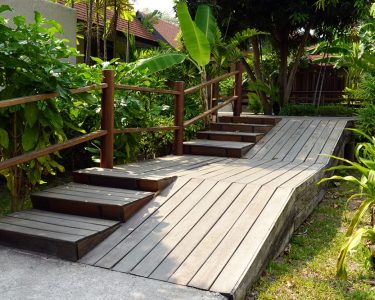
Permanent ramps typically need permits and take four to six weeks from application to finished concrete. It can run longer when the local building department falls behind on applications. A contractor can install modular ramps in a day and remove them later if the situation changes. The 1:12 slope that ADA accessibility standards recommend means one foot of ramp for every inch of rise. A four-step entry needs at least a four-foot run, and usually more once you account for landings and rail returns.
Door Width and Hardware
Standard exterior doors are 32 inches wide. That is tight for a walker and impossible for a wheelchair. Thirty-six inches is what a walker needs to move through without having to turn it sideways. Measure before assuming.
Round doorknobs are nearly impossible for arthritic hands. Lever handles cost about forty dollars per door and take an afternoon to swap. Replace them on every door your parent will use daily.
Check storm doors too. Many require holding the screen with one hand while opening the main door with the other. Something manageable at 50 becomes genuinely difficult at 80 with balance issues.
Most families overlook deadbolt placement. Someone with limited shoulder mobility cannot comfortably reach anything mounted above 48 inches from the floor.
Driveways, Paths, and Parking Access
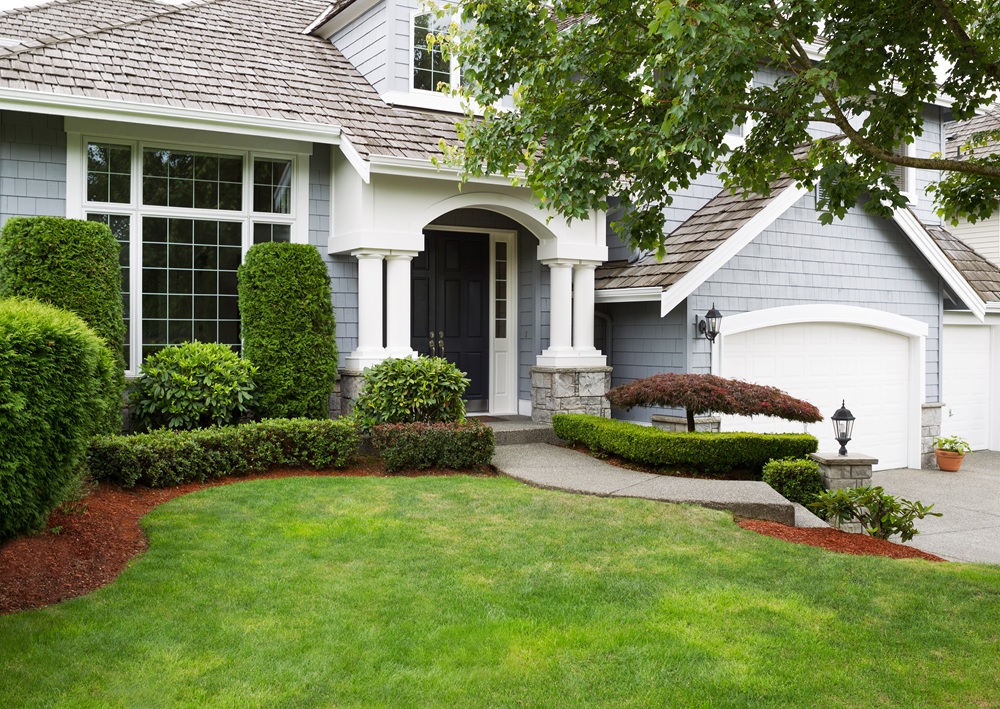
One thing families with elderly parents moving in consistently underestimate is the path from the car to the front door. Walk it as if you are using a cane. Take your time. Notice what your feet catch on.
Cracked concrete, uneven pavers, and roots pushing up sections of walkway are the most common problems and the easiest to underestimate. A crack that a younger person steps over without breaking stride is a real obstacle for someone whose gait has shortened. Gravel paths look natural and low-maintenance right up until someone has to cross them with a walker.
Check where the car will actually park relative to the entrance. A long walk across sloped lawn or an uneven surface in February is a completely different experience than the same walk in July. If the driveway slopes toward the entrance, even a slight grade creates instability for anyone whose balance is not what it used to be.
A rail along any outdoor path or driveway slope above roughly five percent gives a parent something to hold on the way in and out.
Most families don’t think about where a caregiver’s car will park until it becomes a problem every visit.
Think about it now: can a car pull close enough to the door that your parent isn’t walking far before they have support? In the Chicago area, where Lake Michigan drives sharper freeze-thaw cycles than most inland climates, walk the driveway and path twice a year: once before the first freeze and once after the thaw.
Outdoor Lighting That Actually Works at Night
Most exterior lighting exists to look good on a listing photo. It does nothing for what aging eyes actually need at ten o’clock at night.
Walk the full path after dark before move-in. Not a quick glance from the porch, the actual walk, at the speed your parent will move. Notice where the shadows land, whether the edge of each step reads clearly, and where the motion sensor clicks off before you reach the door.
Motion-activated lights cause a specific problem for slower-moving people. The light turns on when they arrive and clicks off before they reach the door. In high-traffic areas, swap them for always-on fixtures on a timer or photosensor.
Fixtures that throw light at foot level, not downward from a pole eight feet up, illuminate where each foot is landing. On steps and uneven pavers, that is the difference between seeing the edge clearly and guessing at it.
Check the garage separately. Overhead lighting in most garages casts useful light over the parking space and leaves the area near the door handle in shadow. An older adult who uses the garage entrance daily needs that threshold well lit.
Start the Exterior Work Before Elderly Parents Moving In Day Arrives
Most families with elderly parents moving in start the exterior work too late.
Permitted ramp installation takes four to six weeks from application to finished concrete. It can run longer when the local building department falls behind on applications. In the Chicago area and across the Midwest, exterior construction windows close earlier than most families expect. Once October arrives, contractors book out and the curing weather for concrete and exterior paint narrows fast. Exterior painting and siding repair takes one to three weeks depending on weather and contractor availability. That timeline does not include the time it takes to get someone out for an estimate. Electrical work for lighting upgrades moves faster, but even that requires scheduling.
If you are looking at a move-in date eight weeks out, the exterior work should start today. Six weeks out, you are already behind on anything that needs a permit. Two weeks out: focus on the fast fixes, hardware swaps, lighting upgrades, and modular ramp rentals. Schedule the permitted work for the month after move-in, once your parent is settled.
Exterior Paint, Siding, and Hidden Moisture Problems
Bubbling or peeling near window frames, around door casings, or at the base of siding often means water has worked in behind the surface. The National Institute on Aging has flagged structural deterioration as one of the less visible contributors to falls at home. It is the kind of hazard that does not look like a fall hazard until it is one. When someone moves in full time, daily shower steam, laundry cycles, and cooking change a house that was sitting quieter before. If there is rot starting behind the siding, it moves faster.
Press along the wood trim around windows and door frames with a key or the flat of a screwdriver. If it gives, if it feels soft rather than solid, there is rot that will not improve on its own. Catching this before move-in means scheduling a contractor on your timeline, not theirs.
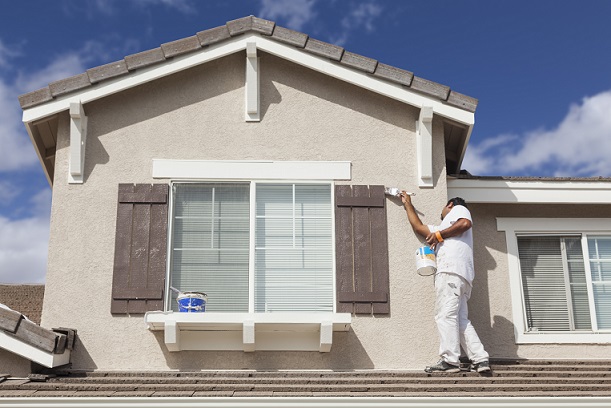
Experienced exterior home painters assess the condition of siding and trim during prep, not just the surface appearance. A quality paint job that starts with a thorough inspection surfaces moisture problems that a quick cosmetic repainting will cover and worsen. If you plan to paint the exterior before move-in anyway, make sure moisture assessment is part of the conversation before a brush touches the wall.
What Comes Next When Elderly Parents Moving In Is the Plan
The exterior work gets the home ready.
Coordinating Care From Day One
Families who arrange care before the move find that the caregiver learns the home’s specific conditions while your parent is still adjusting. The ones who wait until week three, when the family finally has a moment, miss that window.
A caregiver who starts on move-in day knows which path gets icy in January, which door sticks after rain, and where the shadows fall on the back steps. A caregiver called in six weeks later learns all of that after something has already gone wrong.
Once the exterior work is done and the house is ready, many families bring in home care services for the daily support piece, the steady presence that keeps things from falling through the cracks when a parent is living with you full time.
Frequently Asked Questions
What exterior changes do I need to make before an elderly parent moves in?
For families with elderly parents moving in, start with the path from the car to the front door, the route your parent takes every day and the one where a missed hazard shows up fastest. Entry steps, threshold lips, path surface condition, and outdoor lighting are the first things to walk. After those, check door hardware, look for moisture damage around window and door casings, and note how far the car ends up from the entrance. Most homes need at least two or three fixes. Older homes usually need more.
How early should I start the exterior work before move-in day?
Six to eight weeks out for anything requiring a permit. Hardware swaps and lighting upgrades can happen in a weekend. Painting, siding repair, and concrete work need two to four weeks minimum after contractor scheduling. Permits for structural modifications like permanent ramps can add another four to six weeks on top of that.
Do I need permits for ramps and exterior modifications for elderly parents?
Permanent ramps attached to the foundation almost always require a building permit. Modular or freestanding ramps generally do not, which is why many families use them as a bridge while the municipality permits and the contractor builds the permanent one.
Before Elderly Parents Moving In: Where to Start
Most families finish the interior and run out of time for the exterior. Six to eight weeks before move-in is when the exterior work needs to start for elderly parents moving in. Not the week you book the truck. One afternoon outside, walking the property the way your parent will, finds most of what needs fixing. It also leaves enough time to actually fix it.
Sources
National Institute on Aging, Home Safety and Falls
CDC, Falls Data and Statistics
ADA.gov, Accessible Parking and Path of Travel Standards