
The tides are swelling. The thunder’s booming, and the lightning’s bursting everywhere. These are terrifying prospects for any waterfront homeowner. Coastal storms bring tons of raw, unbridled power that can wreak havoc on any marine construction.
That is, if they make the mistake of building against the water, instead of a floating dock that moves with it. A rigid, unyielding structure that tries to fight the ocean’s energy will always lose that battle.
The ocean always wins that fight.
True resilience in marine construction comes from a philosophy of “going with the flow.” The understanding that a structure sometimes must move in order to stay standing. Sometimes, it needs to absorb that force, instead of resisting it completely.
By utilizing floating deck platforms, selecting high-integrity materials, and respecting the environmental landscape, you can build a legacy on the water rather than a recurring repair bill.
Quick Answer: What Makes a Dock Truly Storm-Resistant?
Storm-resistant dock construction is designed to move with the water, not fight it. Floating dock systems, properly driven pilings, high-integrity marine-grade materials, and professionally installed bulkheads all reduce storm damage risk. A qualified marine contractor using a design-build approach accounts for surge, wave energy, shoreline conditions, and environmental regulations to create long-term waterfront resilience.
Why Floating Dock Systems Outperform Fixed Piers During Storm Surge
“Resilient” and “strong” may sound like they’re in similar boats. But in dock construction, you’d be surprised by how big the difference is. A rigid fixed pier might seem like the safer bet at first glance. It looks solid. Immovable. Permanent.
But during storm surge, that rigidity becomes its biggest weakness.
When high tides and pounding waves slam into a fixed deck, the upward and lateral pressure can be immense. Often, it’s enough to drive the critical pilings out of the seabed or twist the entire deck assembly beyond repair. The more the structure resists movement, the more force it absorbs.
That’s why floating dock systems are usually a better solution in hurricane-prone coastal regions. If you’re evaluating long-term durability, it’s also worth understanding how long a floating dock lasts under real-world conditions. Lifespan depends heavily on materials, installation quality, and exposure to storm cycles.
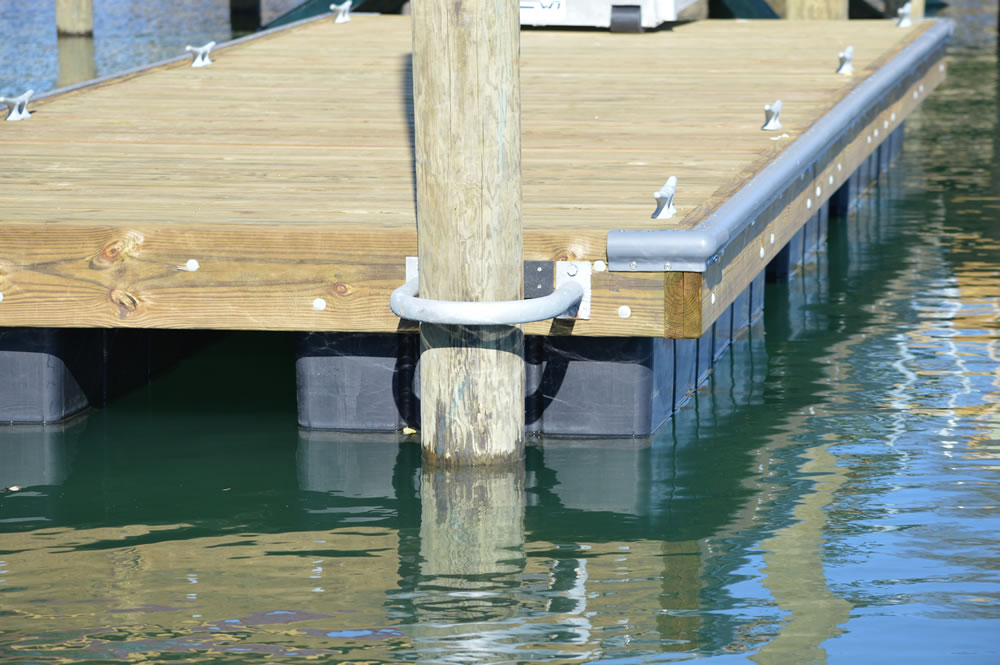
For example, a 470-foot pier in Wilmington, NC, took Hurricane Florence’s full force. The homeowners’ neighbors came back to find their piers obliterated, but the floating deck platforms weathered the storm beautifully.
But why does that happen?
Because the floating deck platforms “gave just enough” during the prolonged pounding of high tides. They moved with the water instead of fighting against it, so there was less vertical pressure on the driven pilings.
Floating systems may need a higher upfront investment. That much is true, but what would you rather pay? A bigger upfront costs, or having to fully rebuild your dock?
That’s the engineering philosophy behind resilient marine construction: allow controlled movement to preserve structural integrity.
Choosing Marine Construction Materials That Withstand Hurricanes
Resilience is what you get when you combine design philosophy and material science.
Aesthetics help reflect a homeowner’s distinct vision for their waterfront property. Durability is dictated by how materials behave under extreme stress. Material selection is the difference between surviving a hurricane or becoming debris.
Professional marine construction demands materials specifically chosen for their ability to withstand repeated wave impact, salt exposure, and lateral storm loads without loosening, corroding, or shearing.
This involves:
- High-Quality Fasteners: Marine-grade hardware engineered to resist corrosion and withstand significant lateral forces.
- Heavy-Duty Decking: Materials with enough density, weight, and structural grip to remain stable during extended wave impact.
- Structural Integrity: Workmanship that is evident in every connection point, from the pilings below the waterline to elevated structures like gazebos.
When technical precision is required, a seasoned marine contractor with regional experience becomes invaluable.
An experienced dock builder understands how to balance aesthetics, engineering performance, environmental conditions, and budget to deliver lasting value rather than short-term savings. And if your waterfront setup includes lifts or elevated components, it’s helpful to know how long a boat lift should last in a coastal environment exposed to salt and storms.
Why Bulkhead Installation Is Critical for Shoreline Protection
Yes, the dock is the focal point of your property’s waterfront. But the first and most important line of defense is bulkhead installation.
A properly designed bulkhead protects upland property from erosion, shoreline collapse, and structural compromise. It stabilizes the land that supports your dock, boardwalk, and surrounding structures.
Keeping your waterfront resilient requires treating dock construction and bulkhead installation as the same project, not separately.
When a bulkhead’s not properly installed, erosion can ruin your pier or gazebo’s foundation. That’ll undermine even the most carefully built dock if the land underneath shifts or recedes.
Professional marine construction requires a coordinated design-build approach. Every element must be engineered to function in harmony with local tidal patterns and soil conditions. The same unified planning philosophy applies to other waterfront upgrades, whether you’re building shoreline features or exploring projects like upgrading to a luxury concrete pool without the headaches.
How to Navigate Coastal Permits Without Delays or Surprises
A lot goes into building on the water. It requires coordinating with government bodies like environmental agencies and archaeological authorities.
If a construction site lies within an archaeological zone or protected area, additional permitting and planning steps may be required before any physical work begins.
Waterfront homeowners enjoy a hands-free experience where in-house specialists coordinate surveyors, engineers, land planners, and permitting officials.
An experienced marine contractor ensures your dock construction project is structurally sound but fully compliant, properly scheduled, and strategically executed.
Thoughtful planning also allows waterfront homeowners to think holistically about their property. For example, shoreline estates often integrate outdoor living features such as coastal-inspired pools, similar to those highlighted in coastal pool design for Connecticut shoreline homes, ensuring all elements work together visually and structurally.
Why a Design-Build Approach Creates Stronger, Longer-Lasting Docks
True shoreline resilience includes a seamless, precise transition from vision to execution.
A proven design-build process usually follows three structured phases:
- Concepts & Contract: Functional layouts and aesthetic goals are defined while accounting for local, soil conditions, tidal patterns, and long-term durability.
- Planning & Permits: Specialists secure approvals and coordinate compliance with environmental regulations and coastal guidelines.
- Execution & Delivery: Skilled crews mobilize equipment and adhere strictly to engineered specifications developed during the planning phase.
During execution, innovation may be required.
In restricted or environmentally sensitive areas, alternative methods such as directional drilling can allow construction to proceed safely while preserving regulatory compliance and site integrity.
Before final delivery, comprehensive internal quality checks confirm the finished structure reflects both engineering standards and the homeowner’s original vision.
Key Takeaways: How Waterfront Homeowners Can Build for Storm Resilience
- Floating dock systems reduce vertical storm surge pressure
- Flexible dock construction helps prevent piling displacement
- Marine-grade materials and fasteners resist corrosion and storm-related failure
- Bulkhead installation protects upland property from long-term erosion
- Hiring an experienced marine contractor improves compliance, durability, and structural longevity
- Choosing the right dock builder reduces the risk of costly storm repairs and reconstruction
Build a Dock That Survives the Storm and Protects Your Investment
Waterfront resilience reflects a simple truth: structures that adapt endure.
Hurricane-resistant piers and properly engineered bulkheads prove that principle. In marine construction, the goal is not simply to build a structure. It’s to engineer durability against extreme coastal forces.
Don’t settle for dock construction that must be rebuilt after every major storm season.
Choose a strategy that embraces flexibility, superior materials, thoughtful design, and regulatory expertise from day one.
By prioritizing resilience from conceptual planning through final execution, your waterfront property remains secure, functional, and valuable for decades to come.
If you are evaluating a marine contractor for your residential project, choose one with proven experience in storm-prone waterfront environments. It is time to move past rigid thinking and start building with the flow of the water.